
SKUNK!
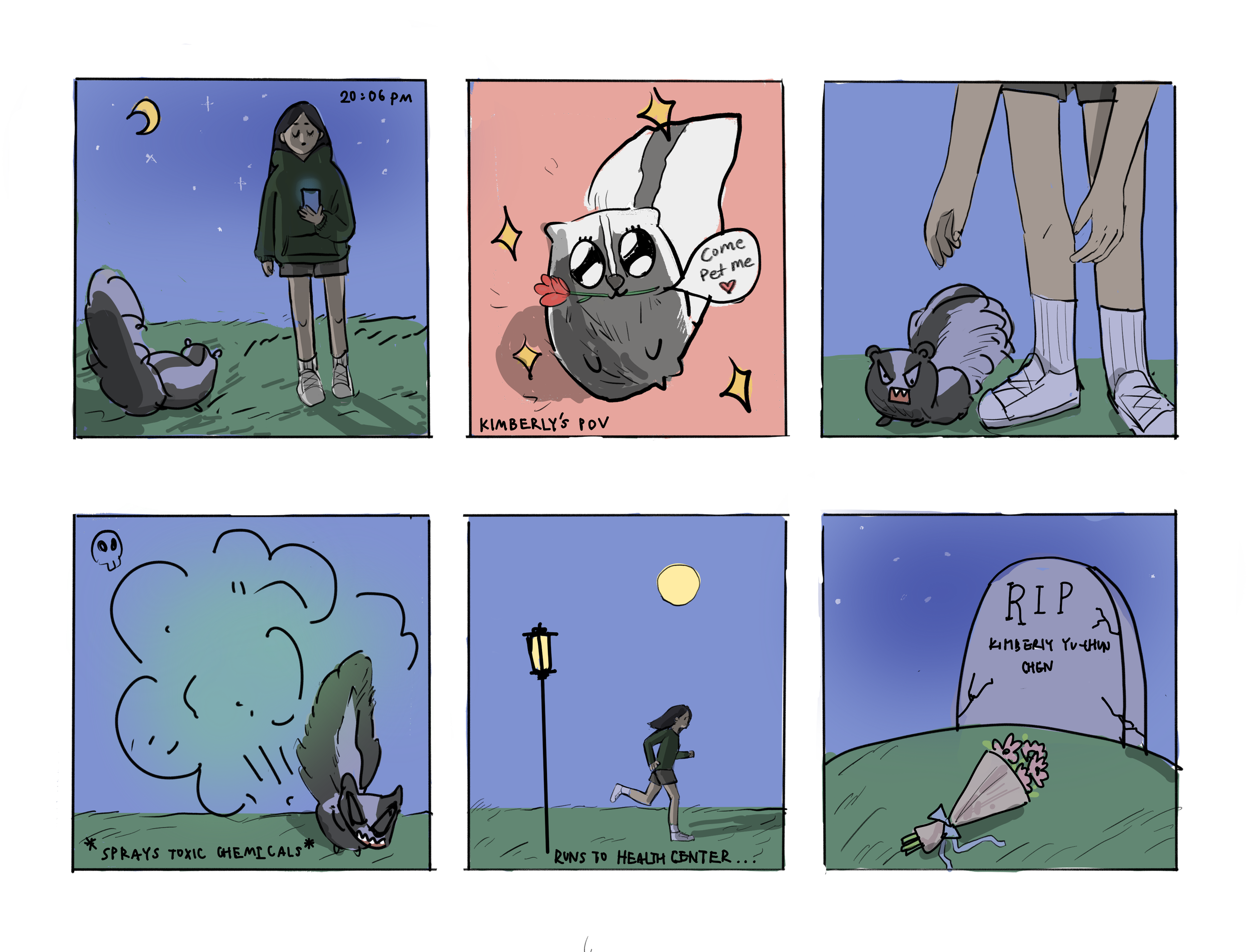
Illustration by Kimberly Chen ’26
______
Ying Kay Leung ’26
On a chilly night last October, Kimberly Chen ’26 was walking by Shea and had her ear pressed against her phone. Glancing around, she suddenly saw a fluffy white tail appear in the grass. Curious, she moved a bit closer. That's when it happened—the skunk lifted its tail and released a pungent and distinctive scent. The smell instantly filled the air. The Shea residents, alerted by the unmistakable stench, immediately knew what had happened outside their dorm.
Similar incidents happen all the time. Each fall, as the air cools and nights come earlier, skunks become more visible on campus. And they aren't alone—squirrels scurry up trees, while ladybugs reside in dorm room ceilings. For students from cities, the sudden shift to rural Western Massachusetts can be a drastic transition. Instead of the noise of car horns and sirens outside, they hear the rustling of animals in the leaves. That kind of wildlife is a reminder that Northfield Mount Hermon is not just a school in the woods, but a community integrated with the surrounding wildlife.
These incidents are more than mere late-night stories; they both reveal a larger reality. NMH is not just a campus, but also a part of the larger Pioneer Valley ecosystem. Learning to coexist without panic or fear is an important part of the experience at NMH. "I saw a fluffy tail," Chen said. "After I was sprayed, I tried to run to the Health Center, but I saw three more skunks blocking my way. I believe all skunks should go extinct," she added. For new students, the presence of so much wildlife can first come as a shock. A new sophomore student from Hong Kong who wanted to remain anonymous said she had never seen this much wildlife before coming to NMH. "The first time I saw one, I was confused and scared because I've heard they attack people."
To better understand the animals that appear on campus, I spoke with our Environmental Studies and Sustainability Coordinator, Pete Sniffin. Pete explained how students often see skunks as aggressive animals. "Skunks don't really want to spray; they aren't aggressive. They would rather not waste that spray, because they can only spray three or four times a week," he said. Pete also encouraged us to see the bigger picture. "Skunks and other animals are all a part of our biodiversity in this area," he said. These animals remind us that NMH is not a bubble, but part of the wider Pioneer Valley ecosystem. Their presence – even though skunks aren't directly 'useful' to us– shows a healthy and balanced ecosystem.
Pete offered a few tips for students as well:
Give them room: If you see a skunk, stop, and don't approach it. If the skunk is directly blocking your path, give it time and let it wander away before proceeding.
Light your path: Having a flashlight while walking in the dark can be helpful to avoid being surprised.
Look for signs: Before skunks spray, they give a few signs such as hissing, raising their tail, and arching their back.
Protect your space: Remembering to close windows and doors can prevent bugs from crawling into your room.
What happens if I get skunked? If you get skunked, try to make your way to the health center, and they will provide you with hydrogen peroxide to help you get rid of the smell.
At NMH, wildlife isn't just scenery; it's a part of our daily life. Students watch squirrels chase each other, learn to deal with bugs in their room, and carefully avoid skunks during the night. It's a messy, funny, and sometimes smelly reminder that campus is part of a larger environment we share. In the end, these encounters teach us that learning at NMH is not only confined to the classroom through exams, but also about discovering how to live responsibly in a world we share with many others.
