
From Muhammad Ali to Gloria Steinem: Speakers That Echoed Through NMH
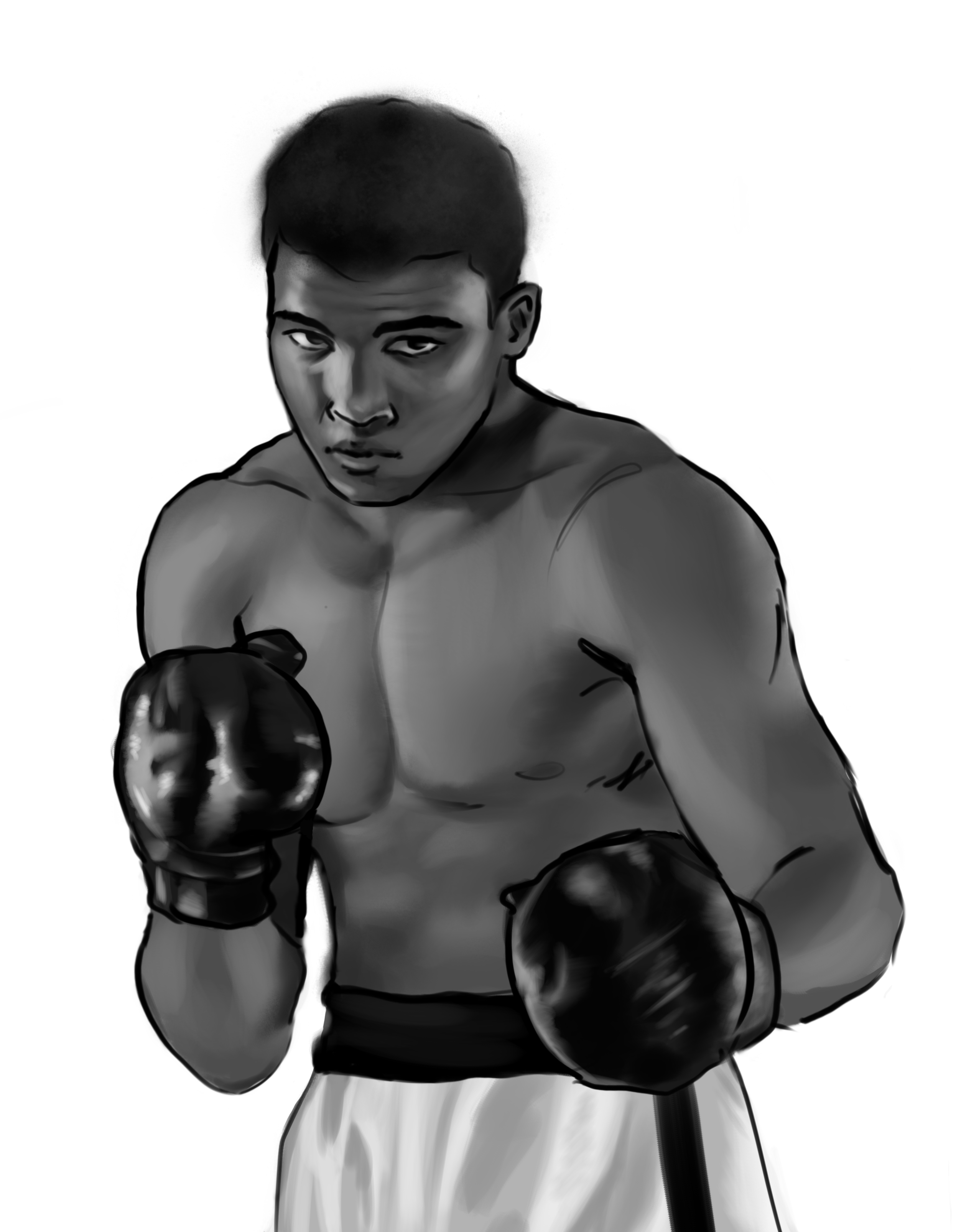
Illustration by Serafina Wilson ’26
______
Mason Stults ’26
On a quiet morning, the hills of Northfield Mount Hermon feel far removed from the noise of history. Yet, time and time again, some of the most powerful voices in America have found their way here – voices that challenged, inspired, and changed the students who listened. From a world champion who spoke about truth and friendship, to a feminist icon who redefined equality, to a band whose music filled the campus before fame ever found them, NMH has long been a crossroads where imagination meets conviction. And through it all, its student journalists have been there to capture the words that echoed through the valley and across generations.
One of the most memorable visits to NMH was in 1974, when Muhammad Ali came to campus during the Afro-American Society’s Black Arts Festival. At the time, Ali was more than a world champion boxer. He had become a symbol of conviction and resistance as a man who gave up his title rather than betray his beliefs about the Vietnam War. For students living in a time of social change, his visit was electrifying. The Bridge, NMH's student newspaper, vividly captured that moment. John Robonson opened the article with Ali’s words: “The man who has no imagination stands on the earth; he has no wings; he cannot fly” (“Ali Visits NMH”). Those words, poetic and proud, carried the message he shared with students: imagination gives people freedom. Ali’s talk touched on friendship, truth, and what it meant to live with integrity. “Truth will make you free,” he told the audience, “not bussing or open housing.” His speech moved between humor and seriousness, and he used poetry to talk about history and race:
We came in chains,
We came in misery,
Now all our suffering
Are part of history.
Students listened closely, writing down every line. The Bridge reported that Ali’s trainer, Kid Galvin, demonstrated the famous bolo punch on stage, and Ali showed the crowd how he planned to defeat George Foreman in their upcoming fight. Robonson even quoted his playful rhyme: “George Foreman is still rising, but the referee wears a frown, because he can’t start counting till Foreman comes down.” Before leaving, Ali wrote one final poem for NMH: “I like your school, and I love your style, but you’re paying so cheap, I won’t be back for a while.” Then he smiled and said, “I’m only kidding” (“Ali Visits NMH”). Half a century later, that article still feels alive. It captures not only Ali’s personality, but also the way NMH students used journalism to connect our small community to national events. Through his reporting, Robonson preserved Ali’s voice as more than a memory–he turned it into a lesson. His writing shows that journalism at NMH has never been just about news; it’s about understanding the meaning behind what happens.
More than forty years after Muhammad Ali’s visit, another historic voice came to campus. On March 29th, 2016, Gloria Steinem, one of the founders of the women’s rights movement, spoke to NMH students about feminism, equality, and activism. Her visit came at a time when national politics were tense–the 2016 presidential election had sparked debate across the country, and those same discussions were happening on campus. That year, the Bridge described NMH as a place full of “mostly civil discourse between everyone on campus from freshmen to faculty,” showing that political conversations were part of daily life (“The Year in Review, 2016”). When Steinem arrived, she “sparked discussion after her visit,” the article noted, describing her as “an empowering figure,” while also mentioning that “others questioned how what she spoke about pertained to young men on campus” (“The Year in Review, 2016”). Those lines reveal something powerful about NMH’s culture of open dialogue. Just as Ali had challenged students to think critically about truth and identity, Steinem encouraged them to question gender roles and power structures. Some students felt immediately inspired by her words; others struggled to connect them to their own experiences. Yet in that difference of opinion, NMH’s greatest strength was visible–a willingness to think deeply, disagree respectfully, and keep learning from conversations.
Steinem’s visit also continued NMH’s long tradition of bringing important voices to rural Massachusetts. Decades earlier, Amelia Earhart had given lectures across the state on women’s independence and the future of flight (“Amelia Earhart”). Though she never spoke directly at NMH, her legacy as a fearless pioneer still resonates with the school’s commitment to empowering students to take bold risks. Earhart once said that women belonged “in science and in the skies,” and that idea of limitless curiosity mirrors the message shared by many who have come to NMH since.
Looking back on these visits, a clear pattern emerges. Whether it was Ali’s fierce honesty, Steinem’s feminist vision, or Earhart’s daring ambition, each visitor carried a message that imagination is freedom. That message also defines journalism itself. To write well–to capture truth–requires the imagination to see beyond one’s own perspective. The story of who spoke at NMH is also the story of who wrote about them. The Bridge had long been more than a newspaper, until its conclusion in 2021; it was a record of how students listen, think, and respond to the world around them. Each generation of writers built on the last, learning that journalism is both a form of storytelling and an act of conscience. As new voices continue to visit NMH, that tradition remains alive through new student publications. The tools may have changed–from typewriters to laptops – but the mission has not. The voice that once filled the chapel and Alumni Hall now echo in archives and memories, reminding future students that education is not confined to classrooms. It lives in conversation, in curiosity, and in the courage to bear witness.
Muhammad Ali’s words still say it best: “The man who has no imagination stands on the earth; he has no wings; he cannot fly.” His message, like Steinem’s and Earhart’s, still challenges every student and writer to imagine more, think freely, and let their words take flight.
