
Finding the Gradient: How Mr. Kerai is Redefining Math at NMH
Photos by Ben Rosenthal ’27
______
Sean O ’28
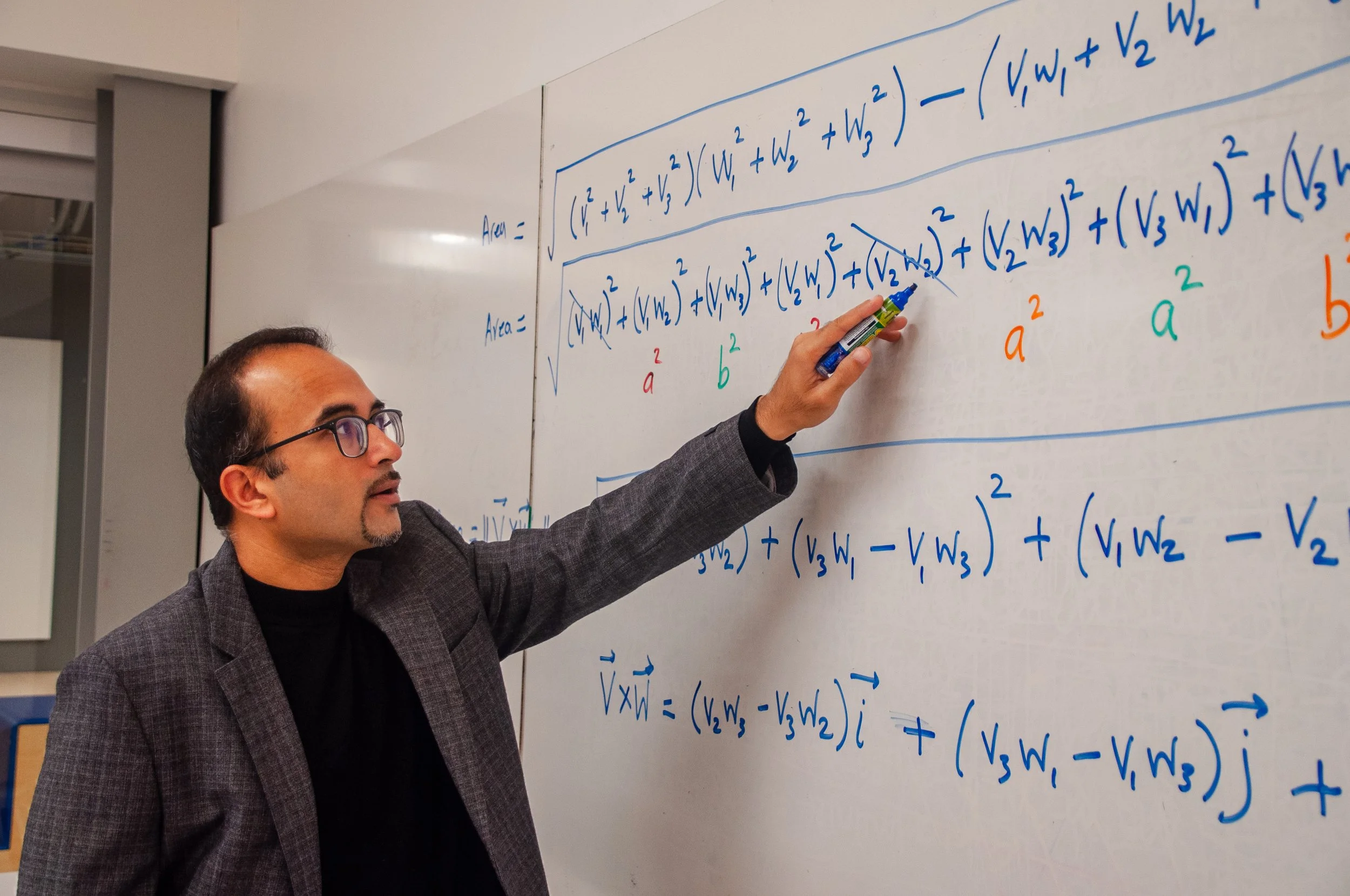
Walking into a classroom led by Mr. Kerai, it’s immediately clear that you’re not stepping into an ordinary math class. There’s a special energy, laughter, and curiosity among the students, but beneath it all, there’s a sense of something deeper happening in every lesson. Students aren’t just learning math to memorize formulas or techniques. They’re being invited to think about what the essence of mathematics is.
Yousef Kerai, who joined NMH this year from Pakistan, teaches Multivariable Calculus and Algebra II, two courses that often make students feel intimidated. But Mr. Kerai is no ordinary teacher; his approach to teaching math turns moments of intimidation into opportunities for exploration and dialogue. He teaches students not only how to solve problems, but why they think of it in that way, and what it says about them as human beings.
“Mathematics,” he explains, “is not just numbers or symbols. It’s a human endeavor, a man-made construct. Of course, we are perhaps finding and articulating patterns that exist in the universe, but the medium by which we do that — the way we express and understand math — can change over cultures and time.”
This simple idea shapes everything about his teachings. For Mr. Kerai, math is not a static collection of truths discovered long ago, it is a never-ending process of how humans try to describe the world around them. His classroom becomes a laboratory where abstract ideas turn into conversations of culture, creativity, and meaning.
Being a music teacher as well, Mr. Kerai often draws parallels between math and music, two universal languages he believes can express the beauty of human thought. Before coming to NMH, Mr. Kerai was not only a math teacher, but also a tabla musician in Pakistan, making him deeply involved in traditional South Asian music. This experience influences the way he sees patterns and relationships, whether in musical rhythms or in mathematical equations.
“Both math and music are ways of understanding order,” says Mr Kerai. “They allow us to translate complexity into something that feels beautiful, something that resonates. Music moves us emotionally while math moves us intellectually, but both are forms of expression that can cross cultures.”
That sense of connection between mind, emotion, logic and creativity is what sets his classroom apart from the rest. Rather than seeing math as a subject based on memorization and mastery, he presents it as something to be experienced. Students are encouraged to ask questions, take risks, and find their own voice within the discipline.
The idea that math is simultaneously universal and deeply human lies at the heart of Mr. Kerai’s teaching philosophy. He wants students to see mathematics beyond just equations but discussions about human curiosity, cultural exchange, and the evolution of knowledge. “We tend to think of math as fixed,” he said. “But in truth, it’s a reflection of how humans think — and that changes. The way ancient mathematicians saw geometry is different from how we see it today. That doesn’t mean one is wrong and the other is right, it just shows that learning is alive.”
Through that lens, math becomes not a barrier between people, but a bridge, a shared pursuit of understanding that transcends background and language. It’s an idea that resonates deeply in NMH’s globally diverse environment. “What I love about NMH,” he said, “is that I get to teach students from so many different cultures. That diversity enriches how we learn math. Each student brings a different way of seeing patterns, and that’s powerful.”
Indeed, in his classroom, Mr. Kerai’s beliefs are reflected in every lesson. Equations are often accompanied by analogies, humor, and sometimes even stories. He talks about a derivative to musical rhythm, or talks about the melody in a proof. He often pauses mid-lesson to ask students why or how a theorem came to be, or what we see when we grasp a difficult concept — turning what could have been lectured to us into something almost poetic.
“The history of math is full of stories of human curiosity,” he said. “If students don’t get to experience that, then they miss the soul of it. Maybe it doesn’t make sense right now, but then slowly, you start to rearrange some of the pieces of furniture, and a pattern emerges. Take for example, Andrew Wiles, the person who proved Fermat’s Last Theorem. He said mathematics is like entering a dark room: you’re feeling around for a light switch, and then suddenly your hand comes across it, and everything is illuminated.”
The sense of illumination that he described is what Mr. Kerai wants every student to be taken away from his class. For him, mathematics is not a fixed book of knowledge, but an unfolding story. And in many ways, he challenges one of the most ingrained assumptions of the subject: that math is cold, objective, and detached from emotion. But to him, nothing could be further from the truth. “If you think about it,” he said, “math is the one subject people can proudly say they’re bad at, but that’s only because they’ve been taught to see it as separate from themselves.”
Instead, Mr. Kerai focuses his lessons around curiosity and confidence. He emphasizes the why behind every formula, connecting equations to the minds and moments that produced them. In that way, students begin to see not just how problems are solved, but why those problems mattered in the first place. “You have to go from the concrete to the abstract,” he said. “Applications are important not just for practicality — they’re how we give students access to the beauty of mathematics.”
Mr. Kerai’s philosophy also reflects NMH’s broader mission to cultivate students who think critically, live ethically, and approach knowledge as something alive and evolving. The addition of Mr. Kerai to our community embodies that mission, blending intellectual rigor with cultural openness and personal warmth.
Outside of the classroom, he’s known for his kindness and humor, often stopping to chat with students or share stories from his home. His laughter is contagious, his enthusiasm genuine. In a subject that can often feel isolating, he offers a space for collaboration, creativity and shared joy. His voice carries a strong conviction: math belongs to everyone, and beauty and logic work harmoniously rather than as opposites. But of course, not every class is filled with math and theories; laughter is never far away, even when it involves something as small as a bag of Cheetos. During one particular class, I brought a bag of Cheetos to class, sparking a series of jokes from Mr. Kerai, such as finding the gradient (the fastest route) of the Cheetos from the table to my backpack. What started as a joke became a metaphor for how he teaches: finding joy, creativity, and humanity in the smallest moments.
That, perhaps, is the essence of his philosophy. For Mr. Kerai, math is not confined to his classroom; it lives in patterns, in music, in laughter, and above all, math lives in the endless human drive to connect and understand. In redefining how students at NMH experience math, he reminds us that numbers and symbols are only a fraction of the story. The real lesson lies in curiosity, in appreciating beauty, or simply in finding the fastest way to put the Cheetos back in the bag.
